
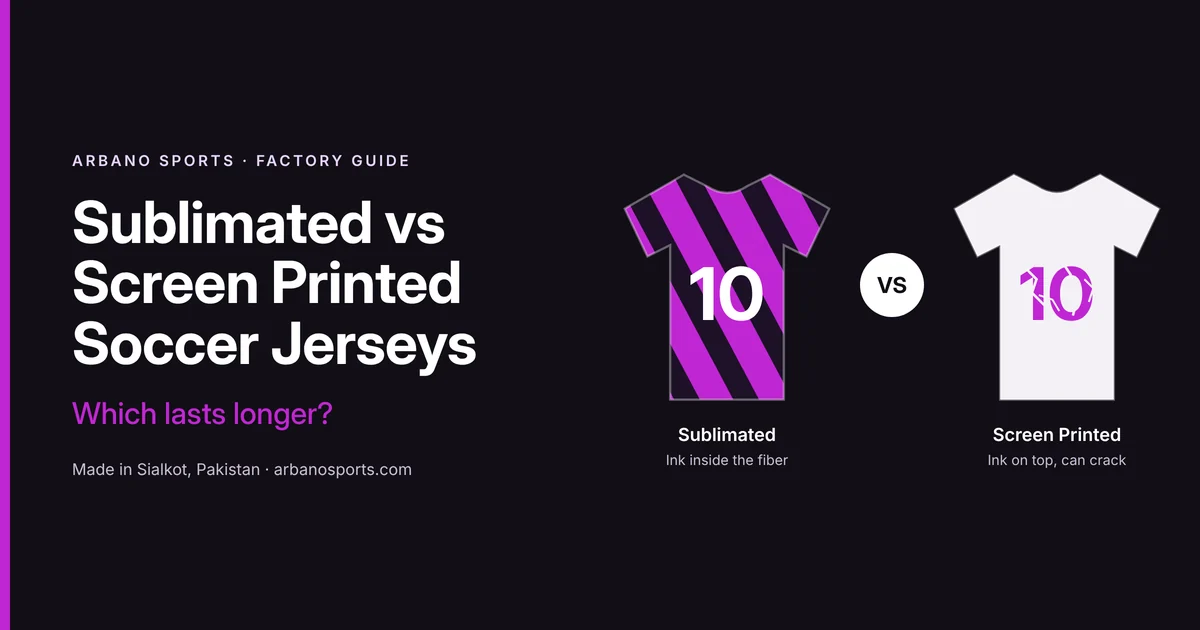
Short answer: Sublimated soccer jerseys last longer. In sublimation, the ink turns into a gas under heat and bonds inside the polyester fibers, so there is no layer on top of the fabric to crack or peel. A screen print is a layer of ink sitting on the surface, and after enough washes and dryer cycles it starts to crack where the fabric stretches. Screen printing still makes sense for simple one or two color designs, cotton fan wear and some numbering.
| Sublimation | Screen printing | |
|---|---|---|
| Where the ink sits | Inside the polyester fibers | On top of the fabric |
| Cracking or peeling | Does not happen | Common after many washes |
| Colors per design | Unlimited, no extra cost | Each color needs its own screen |
| Fabrics | Polyester only, white or light base | Cotton, blends and polyester |
| Feel and airflow | Same as the bare fabric | Large prints feel heavy and trap heat |
| Best for | Full match kits, stripes, gradients, sponsor logos | Simple logos, cotton tees, large runs of one design |
We make both kinds of decoration in our factory in Sialkot, Pakistan, and most clubs that send us a design end up choosing sublimation for match kits. Here is why, along with the cases where screen printing is still the better call.
How does sublimation work on a soccer jersey?
Sublimation starts on paper, not on the shirt. We print your design in mirror image onto transfer paper using sublimation inks, then lay that paper on white polyester fabric panels and press them together at around 200°C. At that heat the ink skips the liquid stage and turns into a gas. The polyester fibers open up, take the gas in, and close again as the fabric cools. The color is now part of the fiber itself.
In our embellishment department, we sublimate the flat panels before anything is sewn. That is why a sublimated design can run cleanly across the shoulder seam, around the collar and down to the sleeve cuff. Our stitching team then joins the printed panels, lining up stripes and patterns so they meet at the seams.
Because nothing sits on top, a sublimated jersey feels exactly like the bare fabric. It stays light, it stretches with the player, and sweat moves through it the way the fabric was designed for.
Sublimation does have limits, and it is better to know them before you order:
- It needs polyester. The dye only bonds with polyester fibers. On cotton it washes out.
- There is no white ink. Any white in your design is the fabric showing through, which is why sublimation is done on white or very light fabric.
- Snags can show. If a stud or fingernail pulls a thread, the inside of that fiber can show white. This is rare on match weight interlock but worth knowing.
- Years of strong sun soften colors. Normal match use is fine, but a jersey left on a sunny fence every weekend will slowly lose depth of color.
How does screen printing work?
Screen printing pushes ink through a fine mesh screen onto the garment. Every color in the design needs its own screen, and each one is lined up and printed in turn. The ink, usually plastisol, is then cured with heat so it sets on top of the fabric.
It is a proven method and it does some jobs very well:
- Bold one or two color logos on cotton or blended tees
- Large runs of the same simple design, such as event shirts or fan wear
- Numbers and names added to stock jerseys
The weak points show up on performance wear. A large screen print forms a layer that does not breathe, so a big chest logo can feel hot and stiff during a match. The ink also has less give than the fabric beneath it. Each time the jersey stretches across a player’s back or chest, the print flexes, and over months of washing that flex turns into fine cracks.
There is one more issue that catches many buyers out. When screen printing goes onto colored polyester, the dye in the fabric can rise into the ink during curing. A white number printed on a red polyester jersey can come out pink. Printers prevent this with special low bleed inks, so ask about it whenever you screen print on dark or bright polyester.
Which lasts longer through a full season?
A soccer jersey goes through more than most clothing. Here is how each print holds up to the things that actually wear it out.
| What the jersey goes through | Sublimation | Screen printing |
|---|---|---|
| Weekly washing | Color stays, nothing to peel | Edges start to lift and crack over time |
| Hot dryer cycles | Safe on low heat | High heat speeds up cracking |
| Sweat and salt | Passes through the fabric | Can build up under the ink layer |
| Shirt pulls and sliding tackles | Print moves with the fabric | Ink layer can split where it stretches |
| Sun on the sideline | Slow softening over years | Slow fading, plus cracking from heat |
In practice, the print on a sublimated jersey usually outlasts the fabric. When a sublimated kit is retired, it is because the fabric is pilled, snagged or stretched, not because the design has worn off. A screen printed jersey more often looks tired because of the print first.
Want to see your club crest sublimated before you order a full set? Request a free mockup here.
Which is cheaper for a team order?
The answer depends on your design more than on the method.
With sublimation, a design with twelve colors, gradients and four sponsor logos costs the same to print as a plain one color design. There are no screens to make and no charge per color. It also works for small orders, which is why we can make custom soccer uniforms from 10 kits per design, with sizes, names and numbers changing from player to player.
With screen printing, every color adds a screen and setup time. That makes it the cheaper choice when the design is simple and the quantity is large, for example 300 cotton tees with a one color logo. For a club kit with stripes, a crest, sponsors and a different number on every shirt, sublimation is almost always the lower cost per player.
Our pricing drops at 25, 50, 100, 250 and 500 pieces, and decoration is listed as its own line on every quote, so you can see exactly what the print adds.
What about player names and numbers?
Names and numbers are where many clubs mix methods. There are three common options:
- Sublimated into the panel. Cleanest look and nothing to peel, but the number is fixed at production time.
- Heat transfer vinyl or silicone. Pressed on after the jersey is made. This is the easiest way to add a new player in the middle of the season.
- Screen printed numbers. Fine for stock jerseys, but subject to the same cracking as any screen print.
A setup that works well for most of the clubs we supply: sublimate the full design and the roster numbers, then order a few blank spares in common sizes. When a new player joins, we add their number with heat transfer so the kit still matches. We keep every approved design and color reference on file, so reorders look the same as the first batch.
For a premium finish on top of a sublimated jersey, you can also add an embroidered crest or a 3D silicone badge.
Which should your team choose?
- Competitive clubs, academies and high school teams: sublimation for match kits. It looks sharp, lasts the season and does not cost more for complex designs.
- Private label teamwear brands: sublimation. You get full design freedom and no per color charges as your range grows.
- Recreational leagues on a tight budget with a simple design: screen printing on stock shirts can work, especially for large numbers of identical tops.
- Fan wear, cotton tees and hoodies: screen printing, since sublimation does not work on cotton.
- Training tops and pinnies: sublimation for matching club colors, see our soccer training wear options.
Not sure which method suits your design? Send it to our sourcing team and we will tell you honestly.
How can you make printed jerseys last longer?
The way a kit is washed matters as much as the way it is printed. Share these steps with parents and kit managers:
- Turn jerseys inside out before washing.
- Wash in cold water with similar colors.
- Skip fabric softener. It coats polyester and stops it moving sweat.
- Never use bleach.
- Hang dry, or use the lowest dryer setting.
- Never iron directly on a print, vinyl number or badge.
- Wash kits soon after matches instead of leaving them damp in a bag.
How we check print quality before kits ship
Good printing starts with the right fabric. We sublimate on moisture wicking polyester interlock for match kits, and use honeycomb and bird’s eye mesh where teams need more airflow. You can see how we choose and test materials in our raw materials department.
Before any order leaves the factory, our quality check team inspects each piece against your approved sample. They check color matching, how the print lines up across seams, measurements, stitching and every name and number on the roster. Anything that does not match is pulled and remade.
Ready to plan kits for next season? Get factory direct pricing on custom soccer uniforms.
FAQs
Do sublimated soccer jerseys fade?
Not in normal use. The ink is inside the fiber, so washing does not remove it. Years of strong, direct sunlight can slowly soften the colors, but a sublimated jersey keeps its look through a full season of matches and washing when cared for properly.
Can you sublimate on cotton jerseys?
No. Sublimation dye only bonds with polyester, so it washes out of cotton. For cotton tees and hoodies, screen printing or embroidery is the right choice.
Why do screen printed numbers crack?
Screen printed ink sits on top of the fabric and has less stretch than the jersey under it. Repeated stretching during play, along with hot washes and dryer heat, creates fine cracks that grow over time.
Is sublimation more expensive than screen printing?
For detailed designs, usually not. Sublimation costs the same whatever the number of colors, while screen printing adds a cost for every color. Screen printing is cheaper only for simple designs printed in large quantities.
Can sublimated jerseys be dark colors?
Yes. The fabric starts white, but the dye can cover the whole panel in navy, black or any dark shade. The only thing sublimation cannot print is white, so white details come from leaving that part of the fabric unprinted.
Can I add new players to a sublimated kit in the middle of the season?
Yes. We keep your approved design and color references on file, so we can produce extra jerseys that match the original batch. Numbers for new players can also be added with heat transfer onto blank spares.
1 thought on “Sublimated vs Screen Printed Soccer Jerseys: Which Lasts Longer?”